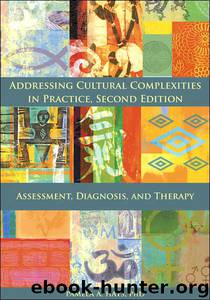
Addressing Cultural Complexities in Practice: Assessment, Diagnosis, and Therapy by Pamela A. Hays
Author:Pamela A. Hays [Hays, Pamela A.]
Language: eng
Format: epub
Tags: Psychology
ISBN: 9781433802195
Google: jg4NAQAAMAAJ
Amazon: 1433802198
Barnesnoble: 1433802198
Goodreads: 2409466
Publisher: Amer Psychological Assn
Published: 2008-09-15T10:00:00+00:00
Obviously, such an approach does not address all of the issues involved in the diversity of purposes for which tests are used. For example, as my former supervisor suggested, children need to be able to perform at a certain level in the mainstream educational system to gain access to future opportunities. Thus, it is still necessary to assess children’s performance in relation to the dominant curricula. However, even with children, an additional emphasis on practical intelligence can be helpful in calling attention to a child’s strengths, avoiding the pathologization of difficulties, and thinking beyond numerically based assessments of a child’s functioning.
In the past, the misguided equation of IQ with intelligence led to the misclassification of many African, Latino, and Native American children as mentally retarded or learning disabled (Suzuki & Valencia, 1997). Some psychologists and educators now emphasize the need to move beyond a focus on classification and rating (exemplified by the IQ score) to an approach that emphasizes understanding and guidance, or description and prescription (Samuda, 1998, p. 173). This latter approach involves more than simply evaluating whether a person can perform a task or not. Rather, the focus is on understanding the reasons for individuals’ performance with the goal of providing recommendations for helping them.
With regard to the assessment of intelligence, this approach may involve dropping the concept of IQ, which represents only a composite of one’s scores on a variety of tasks. Instead, the results of specific subtests may be used to provide details about what the individual can do, cannot do, and might be able to do with help. This approach also involves considering cultural influences on a person’s test performance and functioning. For example, the emphasis of U.S.-based tests on speed of response and completion of tasks without help corresponds to the value European Americans place on cognitive quickness, personal independence, and competitiveness (Pérez-Arce & Puente, 1996). In contrast, many cultures place a higher value on careful thought, cautious behavior, and cooperation with others—values that may negatively affect their test performance but facilitate functioning in their own environments.
Recognizing that European American instruments are commonly exported and used in many nonindustrialized countries, researchers must continue to look for ways to increase the validity of intellectual assessment across diverse cultures around the world. In many previously colonized countries (as well as in U.S. history), intellectual testing was used primarily for selection purposes, namely, to deliberately eliminate poor and Indigenous people from the formal educational system. Unfortunately, even when such exclusion is no longer the intention, it can still have the same result when standardized tests are used to determine advancement to the next grade or level. As Serpell and Haynes (2004) noted with regard to African countries, a more socially productive and less culturally invasive approach involves prioritizing the guidance function of assessment over the selection function—advice that is similar to the description and prescription emphasis.
Wong, Strickland, Fletcher-Janzen, Ardila, and Reynolds (2000) made the following four practical suggestions for cross-cultural neuropsychological assessments; they seem equally relevant to
Download
This site does not store any files on its server. We only index and link to content provided by other sites. Please contact the content providers to delete copyright contents if any and email us, we'll remove relevant links or contents immediately.
| Administration & Medicine Economics | Allied Health Professions |
| Basic Sciences | Dentistry |
| History | Medical Informatics |
| Medicine | Nursing |
| Pharmacology | Psychology |
| Research | Veterinary Medicine |
The Art of Thinking Clearly by Rolf Dobelli(10609)
The 5 Love Languages: The Secret to Love That Lasts by Gary Chapman(9906)
Mindhunter: Inside the FBI's Elite Serial Crime Unit by John E. Douglas & Mark Olshaker(9425)
Becoming Supernatural by Dr. Joe Dispenza(8281)
Nudge - Improving Decisions about Health, Wealth, and Happiness by Thaler Sunstein(7765)
The Road Less Traveled by M. Scott Peck(7667)
Mastermind: How to Think Like Sherlock Holmes by Maria Konnikova(7438)
Enlightenment Now: The Case for Reason, Science, Humanism, and Progress by Steven Pinker(7357)
Win Bigly by Scott Adams(7273)
The Way of Zen by Alan W. Watts(6676)
Factfulness: Ten Reasons We're Wrong About the World – and Why Things Are Better Than You Think by Hans Rosling(4796)
The State of Affairs by Esther Perel(4774)
Gerald's Game by Stephen King(4714)
Man's Search for Meaning by Viktor Frankl(4676)
The Confidence Code by Katty Kay(4319)
Thinking in Bets by Annie Duke(4289)
The Healing Self by Deepak Chopra(3646)
Hidden Persuasion: 33 psychological influence techniques in advertising by Marc Andrews & Matthijs van Leeuwen & Rick van Baaren(3602)
The Worm at the Core by Sheldon Solomon(3523)
